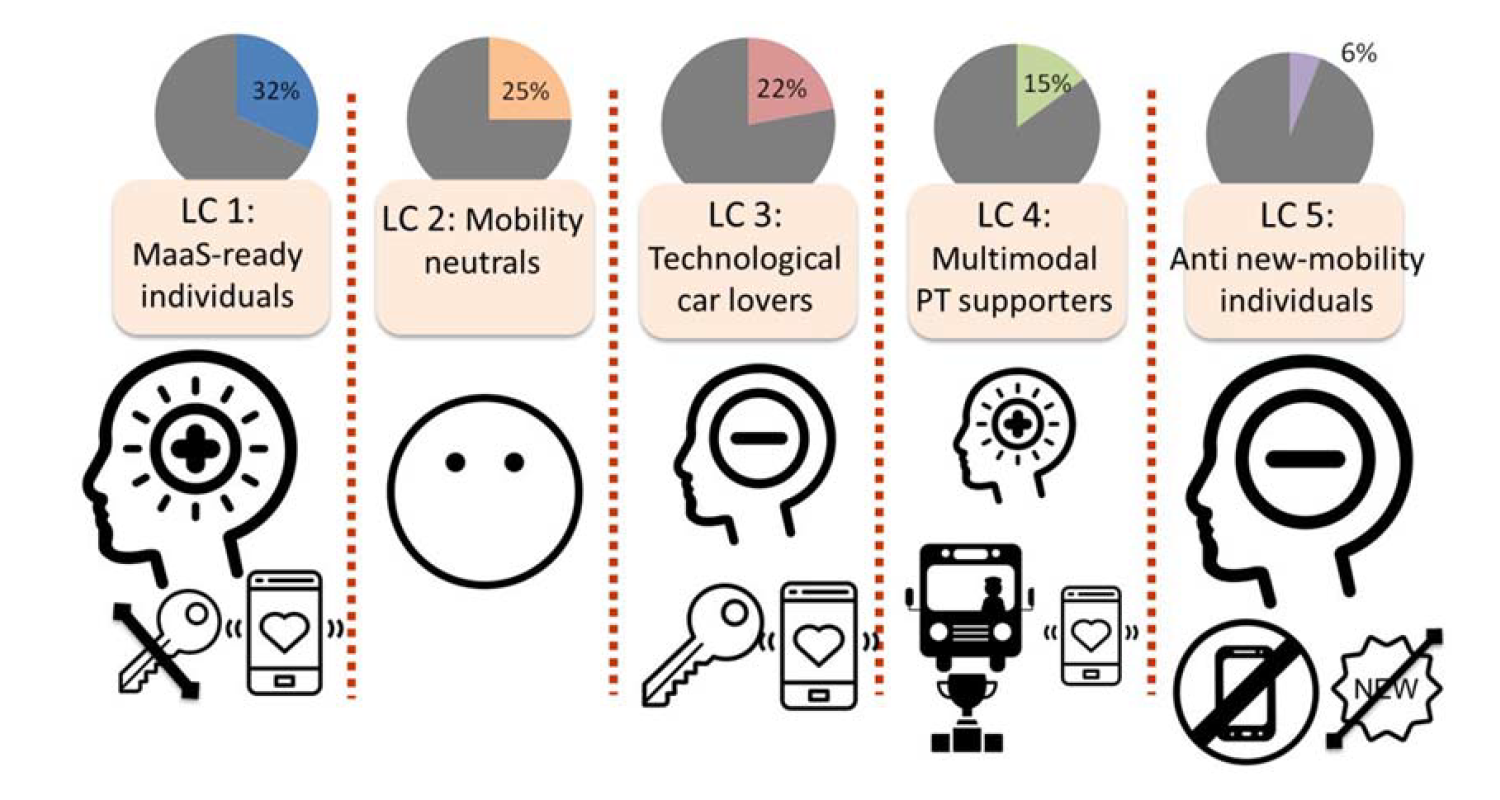
There is a lot of evidence to suggest that (degrees of) integrated services are good and are what people would like to have, but cultural tribalism is a reminder that there are many built in prejudices that are challenging to break if sustainable outcomes are to be achieved. Perhaps another route might be to accept these cultural differences and use improved relevant information and opportunities to experience alternative ways of doing things, so that what we see in different contexts will be different. This is commonly seen through phrases such as ‘I always tend to do what my friends do’, ‘If it is alright for other elderly people than it will work for me’, and ‘the world is becoming too complicated and the cost of finding out is not worth the likely benefits’ (3)
For some, if not most cultural tribes, change will be slow, very slow, and the extent to which MaaS in particular can benefit by change will be inextricably linked back to how well it can demonstrate that the benefits significantly outweigh the costs (including effort) for many cultural tribes or segments. In the Telco context, customers appear to be happy with bundling as long as the increases are minor and incremental (so they are easy to comprehend and digest), and they can see 'value' in the service being offered. If not, we may, in ten years time or even sooner, talk about a program of historical interest that failed: MaaSively impactful may become MaaSively oversold! We hope we are wrong because MaaS has the opportunity to add significantly to sustainable outcomes, but time will tell; and with Covid-19 imposing an even more challenging future, that may be a very long time.
Acknowledgements. We especially thank Natasha Hinrichsen (Policy Director, Mobility as a Service Program Management, Department of Transport and Main Roads Queensland) for many useful comments on earlier drafts; as well as John Nelson (ITLS) and Daniel Reck (ETH Switzerland) for discussions. All view, however, are ours alone.
Endnotes
1 One of the crucial experiences many people had with the Sydney MaaS trial was that they saw their monthly mobility “consumption” in dollars per mode the first time. Once consumers get more used to this, acceptance for bundles might increase, especially with marketing as the secure, easy, “not to worry about” option (mobile phone plans) as they offer a ceiling in the case of flat rates.
2 Outside of the transport sector, there is evidence of a growing area for organisations to have a 'social licence to operate'. This concept is big in the resources sector. As consumers become more environmentally conscious, this type of concept may translate into other sectors with a growing number of companies wanting to be certified as carbon neutral. We might expect that 'culturally' the environmental benefits of MaaS is one of the reasons that the Scandinavian countries embraced the concept of MaaS earlier than other countries. Of course, there is a role for regulators in this space too, in setting the broader societal outcomes that we expect from service operators. (personal communication with Natasha Hinrichsen).
3 It is noteworthy that less than 4% of household disposable income (HDI) is spent on mobile and fixed-line telephone rent, calls and internet charges (Source. The Household Income and Labour Dynamics in Australia (HILDA) Survey, Release 15.). If we exclude the cost of owning a car (~12% of HDI), then we have a similar percentage outlay on transport as on telecommunications.
References
Alonso-González, M., Hoogendoorn-Lanser, S., van Oort, N. and Cats, O. (2020) Drivers and barriers in adopting Mobility as a Service (MaaS) -A latent class cluster analysis of attitudes, Transportation Research Part A, 132:378-401, DOI: 10.1016/j.tra.2019.11.022
Anable, J. (2005) 'Complacent Car Addicts' or 'Aspiring Environmentalists'? Identifying travel behaviour segments using attitude theory, Transport Policy, 12 (1), 65-78.
Edwards, S. and Mulley, C. (2004) How can soft benefits increase the viability of multi-application smart card schemes? Paper presented at 11th World Congress on Intelligent Transport Systems, Nagoya, Japan
Hensher, D.A. (2020) What might Covid-19 mean for mobility as a service (MaaS)? Transport Reviews, 40 (5), 551-556.
Hensher, D.A., Mulley, C., Ho, C., Nelson, J., Smith, G. and Wong, Y. (2020) Understanding Mobility as a Service (MaaS) - Past, Present and Future. Elsevier, published May 18 204 pp. ISBN 9780128200445. Order here.
Hensher, D.A., Ho, C. and Reck, D. (2020) Mobility as a Service and private car use: evidence from the Sydney MaaS trial, submitted to Transportation Research Part A, 11 May.
Ho, C. Hensher, D.A., Reck, D., Lorimer, S and Lu, I. (2020) MaaS bundle design and implementation: Lessons from the Sydney MaaS Trial, submitted to Transportation Research Part A, 10 July.
Mumford, J. (2020) https://www.ttf.org/portfolios... and https://books.google.com.au/bo...
Authors
David A. Hensher and Corinne Mulley, Institute of Transport and Logistics Studies (ITLS), The University of Sydney Business School